Advertising & Branding /
Neon or LED for a Sign That Runs Every Night: The Real Running Cost
Ask for the complete sign's power and service specification before calculating what an evening feature will cost to operate.
By Auronix Advertising
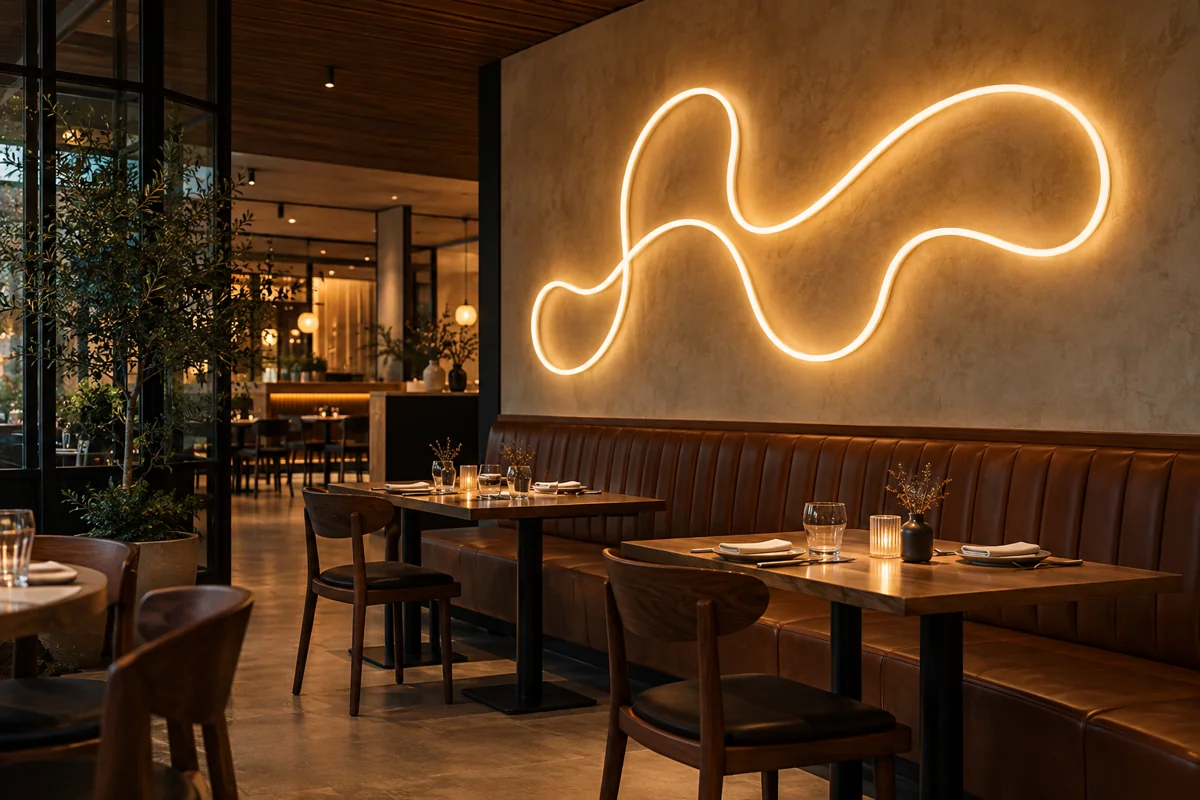
A restaurant sign runs through dinner service, closing and sometimes the cleaning shift. Its electricity use therefore depends on more than the technology named in the quotation. The complete assembly's input power and the hours it is actually switched on determine the energy calculation.
Before choosing between traditional neon and an LED-based alternative, ask what each supplier is proposing. "LED neon" can describe a flexible LED product shaped to resemble a tube, while traditional neon refers to a different construction. Compare two specified signs that meet the same visual brief, not two loosely used labels.
Hold the visual job constant
Give both suppliers the same artwork, intended size, location and viewing conditions. State whether the sign is an indoor decorative feature or an external business identifier. A small indoor accent and a large exterior sign cannot produce a meaningful running-cost comparison simply because both display the same word.
Ask for a representative colour and line-shape sample. If the restaurant's identity depends on a particular glow or detailed script, establish whether each proposal achieves an acceptable appearance before ranking the energy figures. A lower-powered alternative that does not meet the brief is a redesign choice, not an equivalent saving.
Record operating conditions such as dimming requirements and intended switching hours. Let the responsible supplier assess suitability for the environment. Do not assume a product demonstrated on a dry indoor bench is suitable for an exposed frontage or a damp cleaning environment.
Request complete input power
Ask for the proposed sign's total input power at the intended operating setting, including the relevant power-supply components. A figure quoted only for a length of lighting material may not represent the complete installed assembly. Request clarification on what is included and how the figure was established.
Separate nominal ratings from measured operation. A power supply's maximum rating is not automatically the energy the sign uses continuously. Conversely, a claim that the lighting elements are efficient does not tell the buyer the complete system consumption.
Have any measurement or electrical assessment performed by the appropriately qualified supplier. The buyer should receive a clear written figure and its conditions, rather than being asked to open equipment or improvise an electrical test. Keep that information with the final quotation.
Use hours that match restaurant operations
Write the actual switching schedule for an ordinary week. Include pre-opening preparation, late trading and cleaning where the sign remains on. If hours differ at weekends or during seasonal periods, calculate those separately rather than multiplying one convenient evening estimate across the year.
Check who controls the switch. A sign intended to operate for six hours can consume energy for much longer if it is left on after the last team member leaves. A clear operating routine may be as important to the estimate as a small difference between two product specifications.
Where a timer or control is proposed, ask the supplier to specify an appropriate arrangement and explain its use. Avoid adding controls informally after installation without confirming compatibility. The objective is predictable operation, with electrical decisions left to the responsible professional.
Calculate energy before calculating money
The basic calculation is input watts divided by one thousand, multiplied by operating hours. For a purely hypothetical sign using 120 watts for eight hours, the result is 0.96 kilowatt-hours per day. Over thirty identical days, that would be 28.8 kilowatt-hours.
Suppose a second hypothetical proposal uses 80 watts under equivalent conditions. It would use 19.2 kilowatt-hours over the same thirty days, a difference of 9.6 kilowatt-hours. These are arithmetic examples, not representative ratings for neon or LED signs and not a quotation for any supplied product.
This distinction matters. The example shows how to compare two verified input figures without claiming that one technology always saves a fixed percentage. Use the actual supplier data and the restaurant's actual schedule before drawing a commercial conclusion.

Apply the relevant electricity cost carefully
DEWA's published tariff information shows that residential and commercial electricity billing uses consumption slabs and a fuel surcharge, with applicable tax noted. Check the current bill and tariff rather than multiplying by a remembered headline rate.
The extra sign consumption may not be priced like the average consumption across the entire premises. Where a precise estimate matters, ask the person responsible for the business's utility accounts to calculate the incremental effect using the current billing arrangement.
If electricity is included in a lease or recovered through a building charge, establish how that affects the business's own cost. Do not present a theoretical utility saving as cash the restaurant will necessarily retain under every contract.
Add servicing to the comparison
Request the warranty terms, likely serviceable components and the process for arranging a repair. The useful question is how the complete sign is supported, not whether a catalogue claims a long life for one component under particular conditions.
Consider access. A decorative feature within easy professional reach and a sign above a busy entrance can create very different service arrangements. Ask who coordinates access and whether the quotation includes any special equipment or building requirements. Do not make your own work-at-height plan from a rendering.
Ask what the restaurant sees when part of the system fails and how the supplier would restore it. Avoid assuming every LED repair is a quick module swap or every neon issue requires a complete replacement. The actual construction and availability of parts determine the answer.
Compare the whole ownership period
List the installed price, estimated energy cost and clearly identified maintenance assumptions for the period you intend to use the sign. Keep uncertain items as ranges or open questions rather than hiding them inside a precise-looking total.
If one option costs more initially, divide that extra amount by the estimated annual operating saving to explore a simple payback period. Only do this when both inputs are credible and the saving is positive. A result extending beyond the expected tenancy or intended design life may be commercially unhelpful.
Remember that appearance still has value. The business may choose a particular construction because it fits the room or brand better. That is a legitimate design decision when the buyer understands the cost; it should not be disguised as an energy-saving claim unsupported by the figures.
Revisit the estimate after opening
Once the restaurant has settled into its normal operating pattern, compare the assumed switching hours with the actual routine. Staff may discover that the feature stays on during deliveries or preparation that were absent from the original plan. Update the energy estimate with those hours instead of blaming the technology for a scheduling difference.
If the sign is dimmed differently from the setting used for the quote, ask the supplier whether updated consumption information is available. Do not assume energy use changes in direct proportion to a visual brightness setting. Record the supplier's explanation and keep the estimate tied to the way the assembly is operated.
A whole-premises bill is unlikely to isolate one small sign clearly when refrigeration, cooling and trading hours also vary. Treat a change in that bill as a prompt to investigate, not automatic proof of the sign's savings or excess consumption.
Put the decision into the final order
Before accepting the quote, confirm the exact technology, dimensions, sample reference, complete input power and intended operating conditions. Include controls, installation responsibilities and support arrangements. This makes it harder for a later substitution to change the basis of the comparison unnoticed.
At handover, ask the supplier to demonstrate the agreed operating settings and provide care and shutdown instructions. Keep the responsible service contact accessible to the restaurant manager. The staff should know whom to call if the sign behaves unexpectedly rather than attempting an internal repair.
For Auronix neon and LED sign enquiries, bring the artwork, location and intended weekly schedule. Coordinated proposals can then be compared using actual visual and electrical specifications, with the energy arithmetic kept transparent and the maintenance assumptions visible.
FAQs
Does LED always have a fixed percentage lower running cost?
No universal percentage should replace a comparison of actual assemblies. Obtain complete input-power figures for two proposals that satisfy the same brief, then apply the intended operating schedule and current electricity cost.
Is a power supply's rating the sign's consumption?
Not necessarily. A maximum rating and actual operating input are different information. Ask the supplier what its quoted figure represents and whether it covers the complete sign at the intended setting.
How do I calculate daily electricity use?
Divide the complete input power in watts by one thousand, then multiply by daily operating hours. The answer is kilowatt-hours; calculating money requires the relevant current billing arrangement as a separate step.
Should cleaning hours be included?
Include every period when the sign remains on, whether the restaurant is serving customers or not. Ask staff how it is actually operated rather than relying only on published trading hours.
Can I use one electricity rate for the whole estimate?
Use the applicable current tariff and account arrangement, checking slabs, surcharges and tax where relevant. For a precise business estimate, have the person managing utility bills assess the incremental cost.
Is flexible LED the same product as traditional neon?
They are different constructions even when both are described informally as neon signs. Ask the quotation to identify the actual technology, supporting components and representative appearance before comparing options.
Does a long component-life claim remove maintenance costs?
No. A component statement does not establish the complete sign's service needs, access costs or warranty coverage. Ask how the supplied assembly is repaired and which circumstances or parts are excluded.
Should a restaurant measure the power itself?
Electrical assessment should be handled by the appropriately qualified supplier or professional. Request documented input-power information rather than opening equipment or improvising a test to verify a sales claim.
What makes a payback calculation misleading?
Unverified power figures, unrealistic hours, an inappropriate tariff or ignored maintenance differences can distort it. Keep assumptions visible and compare the result with the period you realistically expect to use the sign.
What should be included in the handover?
Request the final specification, operating and care instructions, agreed settings, warranty terms and service contact. Staff should understand normal use and how to report a problem without attempting internal electrical work.
